
Dear Mr. Market:
When we reminisce and think of some of your worst days it would be natural to assume it was sometime during the Great Depression. Believe it or not the worst drop in stock market history (at least percentage wise) was not in 1929 but rather on October 19, 1987.
Click here to see what happened on that day, which is now known as Black Monday.
There were a number of issues underneath the surface that led to that bloodbath of a day but what amplified things was the early practice of program trading. Computers were programmed to execute trades after being triggered by certain conditions and this literally made human traders almost worthless as automation took over!
Two years ago, on the 30th anniversary of Black Monday, we wrote an article and calculated what a drop would be in today’s stock market. Click here to check it out. On that day it would have been equivalent to about a -5,094 points drop in the Dow Jones Industrial Average. If it happened this coming Monday…we would see the Dow Jones go from about 26,965 to 21,033 for a drop of -5,932 points.
Are you ready and what would you do? How is your current portfolio positioned in the event of something even half of that type of drop? We’re not trying to be “doom and gloom” financial advisors but we’re also not so oblivious or positive that we’re “running East in search of a sunset”.
All this being said, get your plan in place now and prepare yourself for such an event. Even if you just let your mind get in front of it and don’t make any portfolio changes, your emotions will at least be more in check. History and reality tells us, however, that most people will read this and not prepare any differently.
PS- Don’t be “most people”!






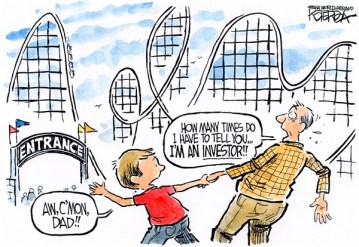 Look…we get it…the stock market can make you lose your lunch. The roller coaster analogies are plentiful and with a 24/7 news cycle it seems like the slightest hiccup can create a bloodbath on Wall Street. All that being said, the odds of the stock market being positive over time are overwhelmingly in your favor and it’s still the place to be if you want to grow your wealth. Over one-year periods, between 1926 and 1997, Ibbotson found that stock returns were positive in 52 out of 72 years, or roughly three-quarters of the time. Even so there is obvious risk and volatility with the best year having stocks return +54% and in the worst -43%.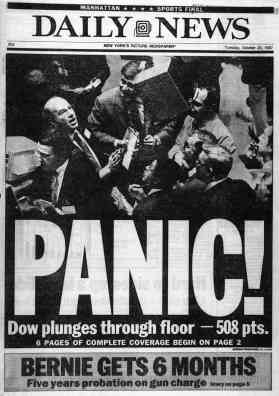
 What matters most in times like this is to level set things and to have a disciplined strategy firmly in place. Our signature approach for accounts over $100k is the Columbus Strategy and aside from its long-term track record what gives many clients some peace of mind is knowing that it ultimately looks to mitigate large and extended stock market drawdowns. We’re not so much focused on one month but over the course of a full market cycle you will be hard pressed to find a strategy that does better.


 Dear Mr. Market: