
Are we climbing the “Wall of Worry”?

slope of hope - wall of worry

Dear Mr. Market:

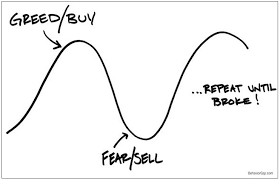
First and foremost, what is the proverbial “wall of worry”? If bad news is bad…why is it that good news (or even mildly good news) … is also perceived as being ‘bad’?


Granted, this is not always the case but it certainly is now. What is the “wall of worry”?

DEFINITION of ‘Wall Of Worry’

“The financial markets’ periodic tendency to surmount a host of negative factors and keep ascending. Wall of worry is generally used in connection with the stock markets, referring to their resilience when running into a temporary stumbling block, rather than a permanent impediment to a market advance.”

Two weeks ago we were in Chicago for discussions with analysts, economists, and elite portfolio managers. What’s interesting is that the majority of the investing public is living in fear and at their utmost pessimistic levels of recent history, yet the underlying economics and pure fundamentals of the stock market actually counter such negative and extreme doom & gloom sentiment.

Continue reading

Is it time to take a bite out of Apple?

apple dmmDear Mr. Market:

For years the world has had a love affair with Apple (AAPL). It has become an amazing company delivering mind-boggling performance to its shareholders while creating a loyal following with its consumers. Over the last 10 years it has rewarded its investors with returns over 1,400%! As volatility has returned to the markets many are asking if this ship has sailed and whether Apple will become another technology stock of the past, replaced by the new ‘tech darlings’ of today. In our opinion… this statement couldn’t be any further from the truth. We feel that the market is presenting investors with a rare buying opportunity in a phenomenal company that is positioned to remain an industry leader for years to come.

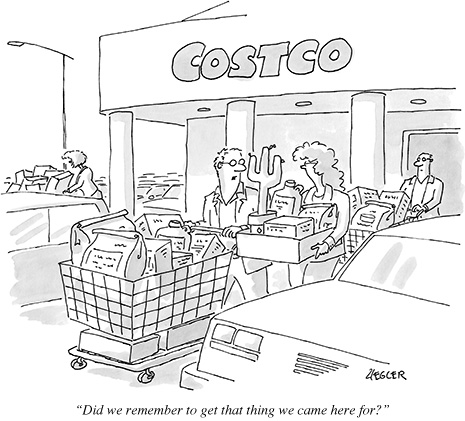
Why is it that people want to buy a stock as it breaks all-time highs? It’s like going into your favorite retail store only on days when they announce that they have marked up all the items you wish to buy. If you were tempted to “take a bite out of the Apple” as the stock approached $140, why wouldn’t you want to buy that same company for almost $30 less per share? Did something change dramatically with the company, their management, or the competition? Continue reading

MPG Core Tactical 60/40: August 2015 Performance Update

MW-BB798_sm6040_20130422180557_MDDear Mr. Market:

If you’ve never experienced a stock market correction until now (technically defined as -10% or more), you have either never invested or have only been investing since 2012. For the vast majority of others, you should know that markets “correct” on average at least once every 12-18 months. One reason why this feels worse than other corrections is because we just went 47 months without a correction of -10% or more! (third longest streak on record)

For a refresher, stock market corrections are short and sharp declines of -10% to -20%. They’re typically accompanied by sensationalized stories such as the European sovereign debt crisis, Greece’s exit from the Euro, or the “fiscal cliff”. For all those investors that ducked for cover and went to cash during the last correction you saw the Dow Jones move up over 6,000 points. Were you able to correctly “time” your reentry into the market? No…and you’re not alone. No matter what you read or hear there is not a single person or professional advisor that owns a crystal ball and can consistently time the market.

If you’re new to this monthly series…remember what we’re doing. This exercise, as we like to call it, is not an attempt to pick the best stock or “time the market”. We leave that futile task to those who own time machines and accurate crystal balls. For a refresher, see our first article on the MPG Core Tactical 60/40 Portfolio.

Here’s the current summary of the MPG Core Tactical 60/40 portfolio mix, which is updated as of this writing (September 1, 2015).

Click here to compare our portfolio against the benchmark.

From the last week in July to this writing the MPG Core Tactical 60/40 portfolio went down -4.49%. How did the rest of the markets do? Continue reading

Is this the much anticipated market correction? Is the sky falling?

chicken littleDear Mr. Market:

Have you heard of the popular children’s story “Chicken Little”? The story begins with an acorn falling on a chicken’s head prompting him to run around declaring that the world is coming to an end, repeatedly stating, “the sky is falling!”   The media has been acting much the same the last few weeks, prompted by the sell off in the equity markets. We’ve discussed the ‘herd mentality’ before, markets like this cause even the most experienced investors to act irrationally and make decisions based on emotions – don’t allow yourself to do the same.

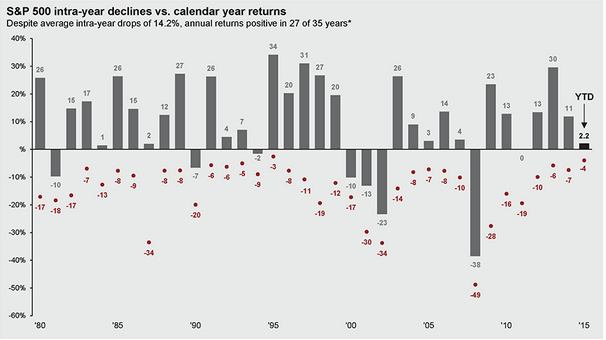
Recently the stock market has been a bumpy ride, it is now entering correction levels. Over the last month the S&P 500 has dropped over -4% and international markets are down as much as -10% or more.   These numbers are alarming but let’s take a moment to keep things in perspective. The S&P 500 is now slightly negative for the year. Last summer (2014) the market was down as much as -7% at one point, did the sky fall then? No, it closed the year up +13%.

Below is a chart from JP Morgan Asset Management, it illustrates the fluctuations that the markets exhibit on a yearly basis showing the low points and where it finished each year. Going back to 1980 the S&P 500 has returned positive results 27 out of 35 years. Here is an even more eye-opening stat – every year since 1980 the S&P 500 has dipped into negative territory! The average intra-year low point for the S&P 500 going back to 1980 is -14% yet the markets finished with average year-end return of 11% over the same time frame. That is not a typo – take a moment to look at the chart below to help put this in perspective!

Intra-year decline chart

This market could get uglier before it gets better. Fingers are being pointed in various directions as to what or who is to blame: The Fed, China, the Energy Sector, Greece and the Euro Zone…and the list goes on and on. The bottom line is that every year there are new economic and global factors that impact the markets. By no stretch of the imagination are we trying to minimize or discount the impact the markets are having on investment portfolios, rather than focus on what has already taken place, let’s look forward. Continue reading

MPG Core Tactical 60/40: July 2015 Performance Update

MW-BB798_sm6040_20130422180557_MD

Dear Mr. Market:

Yes…the stock market is down. Your portfolio is down. There is no way it is not down. We just said the word “down” three times in a row. Get it? Everything is down.

If you have a decently designed and intelligently constructed portfolio you are actually DOWN more than than the overall stock market! What does that mean? Most people look at the Dow Jones as their benchmark. That’s what the media tells you every night as to what’s happened. The media reports on the Dow Jones as though it’s an accurate index to let you know how the stock market is doing. Nope….As you become a more savvy investor you will learn that that the Dow Jones is just an antiquated index that means nothing. Yep….we said that! The Dow Jones means zilch!

Make no mistake about it. This is one of the strangest and least predictable markets ever…

If, however, we were to tell you the Dow Jones was about to get blasted and go down to 6,000 (currently at 17,500) it would be easy to lead you down that road. There are plenty of reasons why the market will get hurt more. Ironically enough…we could paint just as equally convincing a story of how the Dow will go to 20,000! That’s where we’re at right now. When you can find two opinions so extreme regarding the end results, yet each has its merits, you’re in a very precarious market environment.

Continue reading

Costco: You shop there but should you buy the stock as well?

Costco 1Dear Mr. Market:

Take a moment to think of a ‘big-box’ retailer – is it a position that you would like to own in your portfolio? Over the last several years investors have been burned by these stocks as the retail industry has been hit with negative headlines and security breaches while at the same time resisting change in consumers preferences and technology. When investors think of ‘big-box’ retailers the two names that often come to mind are Wal-Mart (WMT) and Target (TGT). There is, however, a name that has become a leader posting impressive returns for years and in our opinion will continue to do so for the foreseeable future.

Costco Wholesale Corporation (COST) is a leader in the Consumer Staples industry that truly embraces and drives change enabling it to earn the loyalty of its members while also recruiting new ones. At the end of 2014 the company operated 664 warehouses with 469 in the United States, 88 in Canada, 33 in Mexico and the remaining 74 in the United Kingdom, Japan, Korea, Taiwan, Australia and Spain. The company was founded in 1976 and is currently based in Issaquah, Washington.

When we look at Costco there are several key factors that differentiate COST from their competitors and in our opinion make a case for why it can serve as a core holding in a diversified portfolio. Today we will not be wearing our ‘analyst hat’ and dig into the financial reports instead we will highlight several compelling points that make Costco a leader and innovator in their industry. Continue reading

MPG Core Tactical 60/40: June 2015 Performance Update

MW-BB798_sm6040_20130422180557_MD

Dear Mr. Market:

Like clockwork you set us up for another stretch of pretending that you wanted to inch up higher and then sold off the last week of the month. How you behaved in May is similar to what you did in June except this time your volatile temper began to show more of a resolve and rattled investors. You began the month with some semi-positive economic news along with dovish Fed commentary all to have it dampened by the Greek debt fiasco.

The S&P 500 lost -2.17% for the month of June. The poor performance turned in by our domestic markets pales in comparison to what has transpired in China. If you’re waiting for another proverbial “bubble” to burst…perhaps it’s here. In about three weeks Chinese stocks sold off sharply losing -30%. We’ll talk more about this later in this article but for those “experts” claiming that this is a good time to buy Chinese stocks, consider the reality that they are still quite expensive. If you think our markets are frothy after a six-year bull market run and a current P/E ratio of 20.5, the median P/E ratio for Chinese companies is still at 55 (down from 108!).

Here’s the current summary of the MPG Core Tactical 60/40 portfolio mix, which is updated as of this writing (July 2, 2015).

Click here to compare our portfolio against the benchmark.

What adjustments did we make? Continue reading

It’s All Greek To Me!

Greece 1Dear Mr. Market:

The financial media loves to move from crisis to crisis and spice things up by creating eye-catching headlines! Over the course of the last few months an old friend has popped back up as the lead story and it isn’t due to being the birthplace of the Olympics or tasty baklava. Greece is once again in a financial crisis and its future will not only impact Europe but also economies around the world.

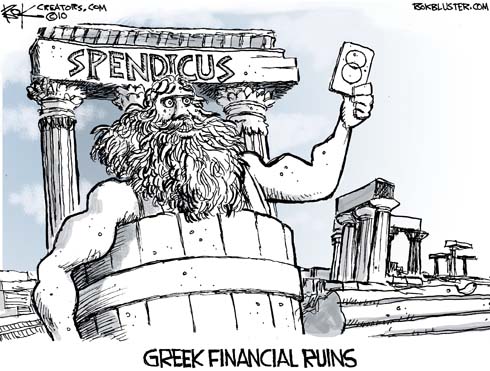
While the issue is complex and there are many moving pieces what it ultimately comes down to is Greece has a spending problem. The country is like a college freshman that just got their first credit card and has gone on spending spree oblivious to any repercussions. Picture that freshman opening their first bill after they have decked out their dorm room and realizing they can’t make even the minimum payment. This is the dilemma that Greece is facing… again!

How did we get here?

 To keep it simple, Greece has built up a mammoth amount of debt by spending more than it generates. The balance sheet for the country is essentially covered in red ink. The retirement age in Greece is 57 (62 in the U.S.) creating an additional burden on the country. Tax evasion is also a huge issue for the country; Greek politicians have often referred to it “as the national sport”. It’s estimated that over $30 billion per year goes uncollected in taxes. Continue reading

What stock market volatility?!?

timthumb.php

Dear Mr. Market:

How crazy has this market been? As always the stock market has been very volatile, right?

Not even close…. The stock market is essentially in a coma right now and you need to ignore whatever news source or preconceived notions that tell you otherwise. The irony is that some of the “smart money” could not have got the volatility prediction more wrong.

In January of this year Scott Wren, senior global equity strategist at the Wells Fargo Investment Institute, predicted dramatic swings in many areas of the market. He summarized this sentiment by saying, “I don’t see this volatility going away anytime soon.” We’re not out to point fingers but it’s blanket statements and unaccountable predictions like this that paralyze people or simply clutter their investment strategies and overall mindsets.

We’re actually in an extremely low level of volatility. It’s been eight weeks since we’ve seen a move of at least 1% or more in the S&P 500 and that hasn’t happened in 21 years! We also just wrapped up the first half of 2015 and there wasn’t a gain or loss of 2% which marks the first time that has happened since 2005. (Click here to see 2015 volatility relative to recent years)

As the stock market inches higher it all comes without a healthy and much needed correction. As of this writing we haven’t had a correction (-10%) for 1,359 days! You can look to our previous articles on how often corrections and pullbacks should be occurring to put this flat environment into perspective.

As an investor you actually should be doing what we would call a “volatility rain dance”. Bring it on! You want volatility. If your long-term belief is that the economy will improve and inflation seems to remain very much in check, you want a pullback in the market in order to put some money to work. Cash sitting in a bank earning “zero point zilch” needs to work harder and smarter but without a material pullback in the market it makes it somewhat uninviting to deploy cash.

Low volatility doesn’t necessarily equate to the “quiet before the storm”…although it’s certainly easy to think that way. The market is not a weather system but rather it needs a catalyst to move strongly up or down. Unless we slip into a recession you can expect the stock market to meander along for a while. If we do indeed continue to trade in a range bound fashion don’t feel the urge to make changes just for the sake of it. Lastly, turn off your television because every sensational interview with an analyst needs to grab eyeballs and predicting low volatility doesn’t fall into that category…

Even a broken clock is right twice a day

analyst 3Dear Mr. Market:

Wall Street is notorious for putting analysts (or any individual) on a pedestal when they make a prediction that happens to be correct. As quickly as their ‘celebrity status’ is awarded it is often just as quickly taken away! The recent downfall of Meredith Whitney offers a lesson that everyone can learn from.

Whitney was awarded her ‘star status’ the fall of 2007 when she made a bearish prediction on Citigroup (C) as an analyst at Oppenheimer. Shortly after she made her call the stock tumbled and the CEO, Charles Swift, resigned. She was credited with predicting the financial crisis that followed in 2008 and became a regular with the business media. With her ‘celebrity status’ she resigned from Oppenheimer in 2009 to form her own firm focused on research and hedge fund management.

It did not take long for her shining star to become tarnished as she missed on several predictions that Wall Street followed her on. She called for municipal bonds around the country to default in 2010 and then in 2013 for the central U.S. to flourish economically while both coasts would struggle. Neither came anywhere close to becoming a reality and Whitney found herself struggling to regain the notoriety that she once enjoyed. Most recently she launched a hedge fund in 2013 that she shut down just last month. Continue reading