Dear Mr. Market:
Every market cycle seems to produce a new crop of companies that investors simply can’t wait to own.
The excitement surrounding an IPO is understandable. A familiar private company finally becomes publicly traded, the headlines build, analysts weigh in, and investors rush to get a piece of the action. The fear of missing out can be powerful.
But there’s a question worth asking before jumping in: Why does a stock need to be purchased on its first day of trading?
History suggests there’s often a pretty good reason to wait.
The numbers tell an interesting story
According to research from LPL Financial, which examined 1,494 IPOs between April 1995 and April 2025, the median IPO was down -4.7% one year after its first day of public trading. Only 46.1% of those companies had a positive return over that period.
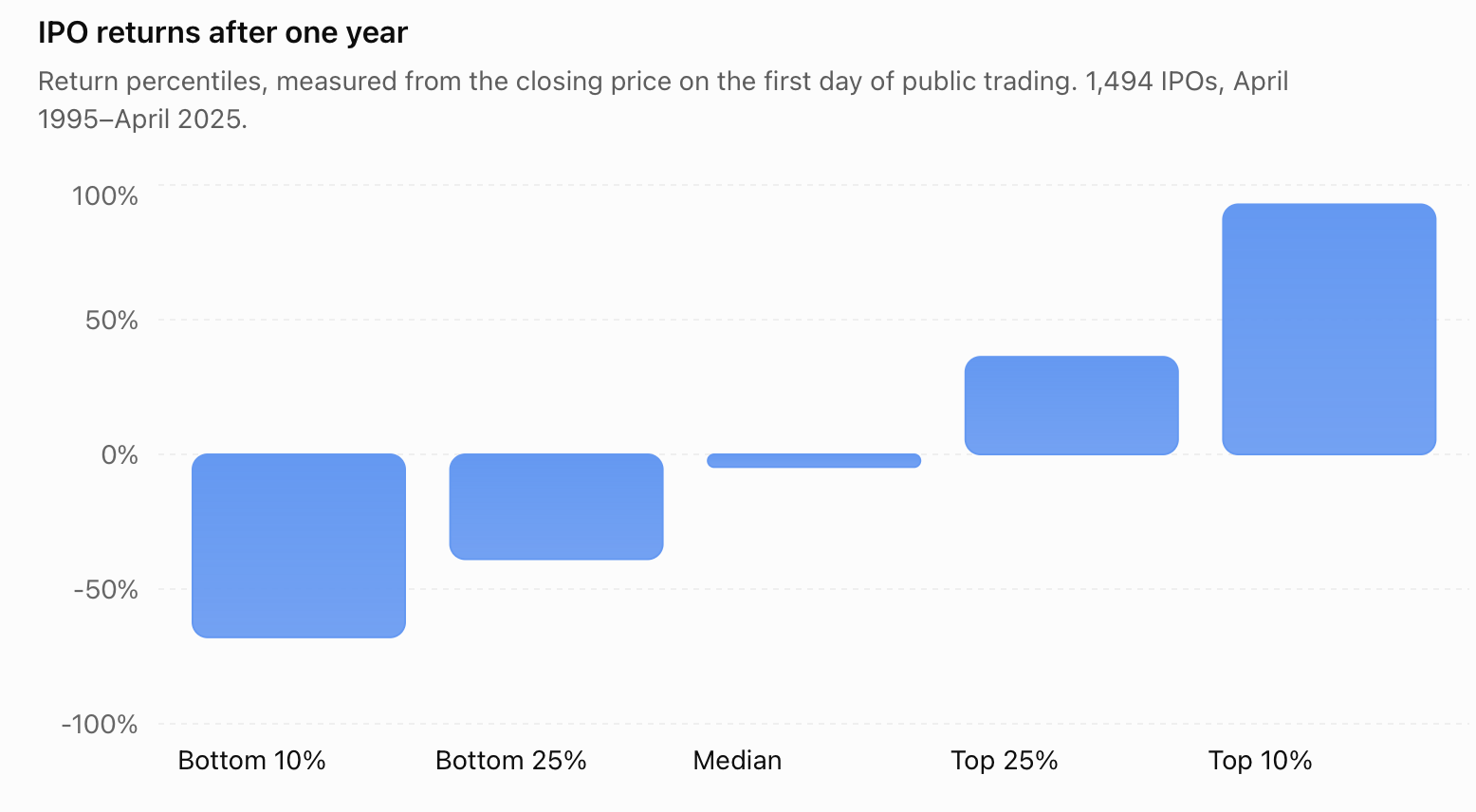
In other words, more than half were underwater a year after going public.
And the ride wasn’t exactly smooth. The median maximum decline during the first year was approximately 48%. Even companies that eventually performed well often experienced substantial losses along the way.
That’s a pretty uncomfortable experience for someone who bought into the initial excitement.
The research also found that IPOs underperformed the broader market by a median of -12.5 percentage points during their first year. So it wasn’t simply a matter of being unlucky with a few individual stocks. The broader IPO group had a difficult time keeping pace with established public companies.
2026: More IPOs, more reasons to be selective
The IPO market has remained active. Stock Analysis lists 268 U.S. IPOs through November 19, 2026, although that is about 15% fewer than the same point last year. If you’re interested, click here to see an up to date listing by stock Analysis.com of all IPOs over the past several years, when and what price they debuted, and where they’re trading at right now.
But a busy IPO calendar doesn’t necessarily mean a better opportunity for investors.
Recent research tracking larger IPOs found that 56% of 2025 IPOs were trading below their original offering price after approximately 120 trading days. The comparable figure for 2026 IPOs was 57% among those with enough trading history to measure.
Another interesting observation: IPOs in this group reached their median peak just 20 to 21 trading days after going public, then experienced a median decline of roughly -49% from that peak.
In other words, the excitement often comes early. The subsequent trading experience can be considerably less exciting.
Why the first day isn’t necessarily the best day to buy
An IPO is not automatically a bargain because a company is well known, growing quickly, or generating headlines.
The offering price is negotiated between the company and institutional investors. By the time shares begin trading publicly, demand can push the market price well above that original price.
Retail investors frequently end up buying after much of the initial enthusiasm has already been reflected in the stock.
Then reality sets in. We’re not saying that you can’t make money down the road, but sometimes humans have short memories, myopia, and FOMO take over before rational thinking and any actual robust evaluation takes place. The chart below is a quick reminder and great visual of some historic IPOs along with their respective price actions following their opening trade.
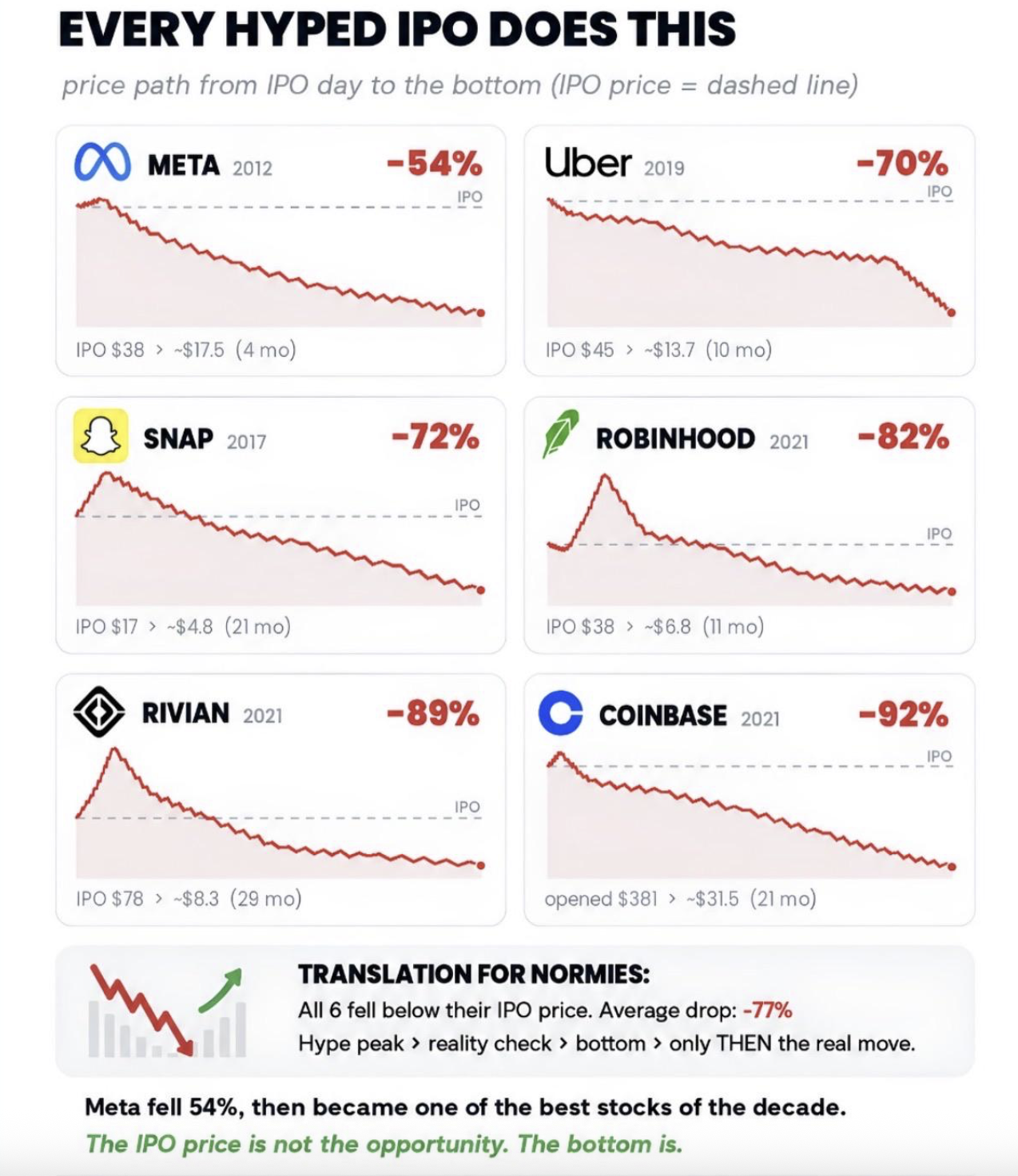
Investors begin evaluating earnings, cash flow, margins, competition, valuation and the company’s ability to meet the expectations built into its share price. Early investors and insiders may eventually become eligible to sell additional shares, adding supply to the market.
None of this means a newly public company is a bad investment. It simply means that being an interesting company and being an attractive investment at today’s price are two very different things.
The latest example: Anthropic
If you want a real-time example of IPO excitement, look no further than Anthropic (ANT).
The maker of Claude AI just completed the largest IPO in history, raising more than $81 billion. Shares were priced at $83, but when trading began on November 19, they opened at $111.50, immediately giving the company a valuation approaching $2 trillion.
That’s an extraordinary debut. And it’s exactly the kind of event that gets investors thinking they need to buy immediately or risk missing out.
But here’s the problem: an exciting first day doesn’t tell us whether a stock is attractively valued. It simply tells us what buyers are willing to pay at that moment.
Anthropic may ultimately prove to be a terrific long-term investment. The company is clearly an important player in one of the most significant technological shifts of our lifetime. But that doesn’t mean every price is a good price.
Investors who bought at $111.50 are paying a substantial premium to those who received shares at the $83 offering price. Whether that premium proves justified remains to be seen.
And that’s the point. There’s no prize for being the first person to own a stock. Sometimes patience is the better investment strategy.
Sometimes the best trade is no trade
There are certainly exceptions. Some IPOs perform exceptionally well right out of the gate and never provide a meaningful opportunity to buy at a lower price. Waiting means potentially missing those gains.
But investing isn’t about catching every opportunity. It’s about making decisions where the potential reward justifies the risk.
Waiting 90 days, six months, or even a year can provide something that isn’t available on opening day: a track record of actual public-market performance.
You get to see how management handles quarterly earnings, how the company performs under public-market scrutiny, whether growth expectations are realistic, and how the stock behaves once the initial excitement fades.
You may also get a much better entry point.
At My Portfolio Guide, we’re not interested in buying something simply because everyone else is talking about it. A compelling story doesn’t automatically make a compelling investment.
The next time a highly anticipated IPO hits the market, remember that you don’t have to be first in line. There will be plenty of time to evaluate the opportunity after the confetti settles.
Sometimes the smartest IPO strategy is simply to let someone else buy it first.
Dear Mr. Market is published by My Portfolio Guide, LLC, an independent, fee-only fiduciary investment advisory firm providing personalized financial planning and investment management to individuals and families nationwide. Led by Matthew Pixa, CFP®, MBA, the firm is committed to putting clients’ interests first, offering objective advice without commissions, proprietary products, or hidden conflicts of interest. My Portfolio Guide is an SEC-registered investment adviser serving clients nationwide.
Learn more about our approach to financial planning and investment management at www.myportfolioguide.com.


