Dear Mr. Market:
A few months ago, when the hype machine was redlining over the SpaceX IPO, we wrote about the dangers of chasing glamorous narratives on day one. We noted how easy it is to get blinded by shiny, new tech stories while glossing over basic valuation rules. We love the excitement of a hot market.
But while the retail crowd is busy looking for spaceships, the most successful investor in human history is quietly building a fortress out of boring, old-fashioned greenbacks.
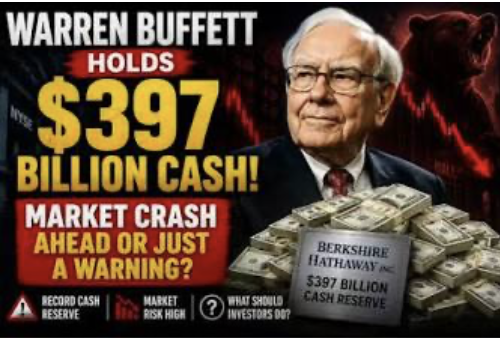
Lately, you’ve given the financial media a lot of ammunition, Mr. Market. The talking heads are looking at Berkshire Hathaway’s balance sheet and shouting from the rooftops. Under the strategic guidance of chairman Warren Buffett and CEO Greg Abel, the cash hoard has climbed to an astronomical $397.4 billion.
Naturally, the “perma-bears”…or those we affectionately call the “Broken Clock Club” (because they’re guaranteed to be right twice a day)…are having a absolute field day. They point frantic fingers at Berkshire’s $400 billion mountain of cash and Treasury bills, screaming, “Look! Even Buffett is hoarding cash because the bubble is about to pop!”
It sounds logical. But it’s a total mirage.
Read more: Warren Buffett Is 60% Cash: Is a Stock Market Crash Coming?The Airwaves vs. The Iceberg
As an insightful Statista analysis by Felix Richter pointed out, the airwaves, the financial press, and social media have been rife with intense speculation. Observers have been desperately trying to read the tea leaves, asking if Buffett is quietly bracing for a brutal economic recession, an imminent market meltdown, or an impending capital gains tax hike.
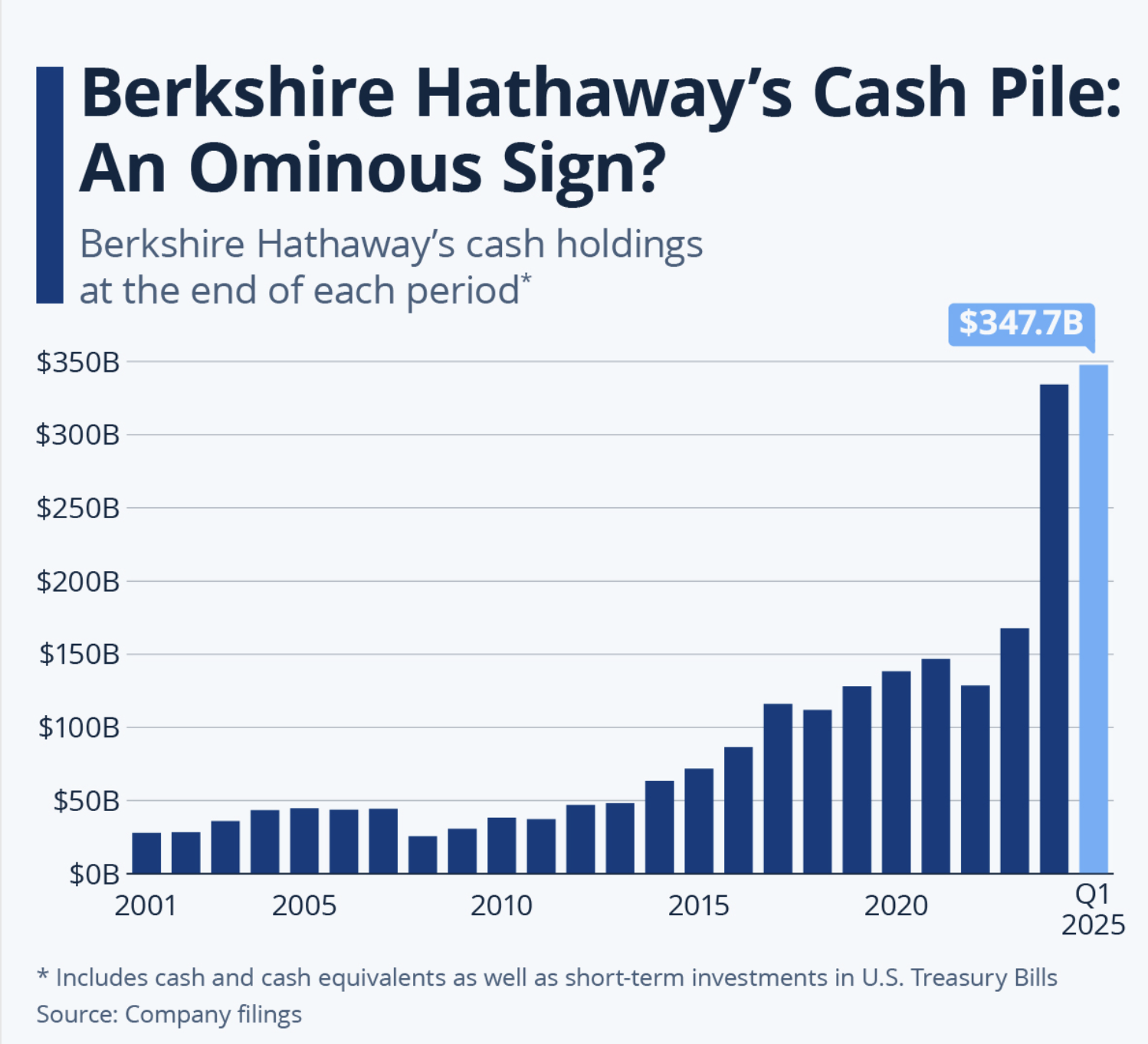
After all, the raw data from the Statista chart above shows that Berkshire more than doubled its cash position in an incredibly short window. If you only look at Berkshire’s liquid investment portfolio, the numbers do look jarring. That cash pile dwarfs the $263 billion sitting in publicly traded stocks. Mathematically, cash makes up a staggering 60.2% of that liquid investment bucket. Compare that to Berkshire’s historical average of around 30.0%, and it’s easy to see why amateur market timers are sweating.
 BERKSHIRE'S LIQUID ASSET MIX
===================================================
■ CASH & TREASURIES | ██████████████ 60.2% ($397.4B)
□ PUBLIC EQUITIES    | █████████       39.8% ($263.0B)
===================================================
But the commentators screaming about an imminent crash are making a classic mistake: they are missing the entire bottom half of the iceberg.
When Berkshire addresses its shareholders, it isn’t just looking at its Apple or Coca-Cola stock. The enterprise is anchored by massive, wholly-owned operating businesses…colloquially known as “controlled equities.”
Think about BNSF Railway, Berkshire Hathaway Energy, GEICO, and an army of consumer icons like See’s Candies or Dairy Queen. These aren’t cash-equivalents; they are highly productive, cash-generating businesses. When you factor the multi-hundred-billion-dollar value of these wholly-owned companies back into the equation, Berkshire’s total capital deployed in actual equities is closer to 70.0%.
Dismissing these exact systemic fears in his annual letter, Buffett gave shareholders a firm reality check: “Despite what some commentators currently view as an extraordinary cash position at Berkshire, the great majority of your money remains in equities.” He went on to emphasize that the value of the company’s controlled operating units has consistently increased, noting that the firm will “forever deploy a substantial majority of their money in equities” because they will always prefer long-term ownership of great businesses over holding cash.
Trimming the Main Sails
Berkshire didn’t build this mountain of liquidity overnight. The firm has been a net seller of equities for 14 consecutive quarters. Management hasn’t been dumping low-quality companies, either. They have been systematically trimming Berkshire’s crown jewels:
1. The Apple Trimming (AAPL)
Berkshire cut its massive, anchor position significantly over the last several quarters. This locked in hundreds of billions in paper profits and reduced Apple to roughly 22% of the U.S. equity portfolio…down from over 40% at its peak.
2. The Bank of America Drawdown (BAC)
A disciplined liquidation program systematically reduced this long-term banking stake by billions. It signaled a highly selective shift away from broad exposure to the banking sector.
These companies aren’t broken. Their valuations simply became rich, and management chose to take chips off the table.
The 5% Luxury of Saying “No”
So, why the cash buildup if they aren’t anticipating a market apocalypse? It comes down to valuation, math, and a core philosophy championed by the late Charlie Munger.
Munger always preached that the key to extraordinary investing was radical patience…having the discipline to sit on cash and do absolutely nothing until an undeniable pitch comes along. As Munger famously observed, “It takes character to sit with all that cash and do nothing. I didn’t get to where I am by going after mediocre opportunities.”
Furthermore Mr. Market, you’ve given Berkshire a luxury it hasn’t enjoyed in over fifteen years… real interest rates.
During the post-2008 era of Zero Interest Rate Policy (ZIRP), holding massive cash reserves was a painful drag on performance. Today, parking nearly $400 billion in short-term U.S. Treasury bills yielding around 4.0% to 5.0% isn’t a penalty box…it’s a weapon.
💰 The Math Behind the Hoard
Let’s look under the hood of Berkshire’s risk-free income stream:
- Total Liquidity: $397,400,000,000
- Assumed Blended T-Bill Yield: ~4.5%
- Annualized Gross Interest Income: ~$17,883,000,000
Note: Even at a conservative 3.1% implied net yield relative to their total asset base, this cash pile quietly generates over $12 billion in annualized, risk-free profit without selling a single stock.
The Real Lesson for Your Portfolio
The lesson here isn’t that you should liquidate your portfolio and wait for a crash. Berkshire isn’t timing the market; they are simply refusing to force a bad trade. They have virtually halted their own stock buybacks because they view their own shares as fully valued, and they are happily collecting billions in risk-free yield while they wait.
It takes an immense amount of behavioral discipline to sit on your hands when everyone else is chasing the latest market flavor. But clarity matters far more than motivation.
Berkshire isn’t panicking, and neither should you. They’ve built a fortress that generates billions while waiting for the right pitch. The great majority of their money remains in the compounding power of good businesses…and that’s exactly where yours should be, too.


