
Dear Mr. Market:
It’s that time of year again. The nets are being cut down, the office bracket pools are being filled out, and somewhere right now a 12-seed is about to ruin someone’s perfect bracket. Welcome to March Madness…the one time of year when a school nobody has heard of can knock off a powerhouse, and when the chalk favorites don’t always survive the first weekend.
We’ve been publishing our annual March Madness Investing Bracket longer than anyone else on Wall Street, and each year it gives us the opportunity to do something most investment firms won’t: put our themes, our convictions, and our best ideas out in public, bracket them against each other, and let the logic play out. Not every pick wins. Not every #1 seed survives. That’s kind of the point.
This year’s tournament feels particularly loaded. Duke and the Boozer twins are the consensus favorite to cut down the nets…a Blue Blood program with generational talent that almost no one is betting against. Michigan, Arizona, and UConn round out the projected #1 seeds. But if March has taught us anything, it’s that favorites get humbled, Cinderella stories emerge from nowhere, and the team that survives isn’t always the one that looked the best in February.
Sound familiar?
Read more: March Madness: Final Four Investing Bracket 2026The market in 2026 feels exactly the same way. The Magnificent 7 have been the Blue Bloods …dominant, well-funded, seemingly unstoppable. But valuations are stretched, the AI capital expenditure story is getting harder to justify quarter by quarter, and some of the most interesting opportunities right now are in the mid-majors nobody is talking about. European rearmament. Nuclear power. A resurgent Argentina. Gold that just won’t quit.
My Portfolio Guide, LLC was the first investment firm to publish a March Madness Investing Bracket, and we’re back with our 2026 edition. As always, the bracket is divided into four regions: Large Cap, Small & Mid Cap, International, and Bonds & Alternatives. Forty-eight investments seeded and matched up against each other, with one champion emerging at the end.
A quick disclaimer before tip-off: The picks in this bracket represent investment themes and ideas we find compelling for 2026. They do not necessarily represent positions held in every client portfolio, and nothing here should be construed as personalized investment advice. Think of this as our annual State of the Market…told through the lens of a basketball bracket. Now let’s play ball. Click here to view the entire 2026 March Madness Investing Bracket and then read below to see more about each region and specific investment.
🏀 LARGE CAP REGION: The Blue Bloods vs. The Challengers
The Large Cap bracket is Duke’s region. Dominant programs, massive resources, household names. But even Duke loses sometimes.
The Large Cap region has been dominated by mega-cap technology for the better part of a decade. These are the Blue Bloods, Microsoft, Nvidia, Amazon…programs with generational talent and seemingly limitless recruiting budgets (read: cash flow and balance sheets). But after years of outsized multiple expansion, the question for 2026 isn’t whether these companies are great. It’s whether great is already priced in.
The Seeds:
- MSFT (Microsoft)
- NVDA (Nvidia)
- AMZN (Amazon)
- TSLA (Tesla)
- AAPL (Apple)
- SPYM (S&P 500 Index ETF)
- LLY (Eli Lilly)
- PLTR (Palantir)
- LMT (Lockheed Martin)
- XOM (ExxonMobil)
- META (Meta Platforms)
- JPM (JPMorgan Chase)
First Round Matchups:
#1 MSFT vs. #12 JPM — The Establishment Clash
Microsoft enters as the #1 seed for good reason. Azure continues to grow, Copilot is being embedded into every enterprise software suite on the planet, and the balance sheet is essentially impenetrable. JPMorgan is a worthy 12-seed — Jamie Dimon has built arguably the most resilient bank in American history, and in a volatile macro environment, financial sector quality matters. But Microsoft’s recurring revenue model, AI integration, and global enterprise relationships are simply too much firepower at this stage. Winner: MSFT
#8 PLTR vs. #9 LMT — The Defense Bracket Dark Horse Matchup
This is the most intriguing first-round matchup in the region. Palantir has transformed from a controversial government data contractor into something resembling the operating system for AI-powered decision-making across both government and commercial sectors. Its AIP platform is gaining genuine traction and revenue growth has reaccelerated. But Palantir trades at a valuation that requires perfection — a multiple that makes even Nvidia look cheap. Lockheed Martin, meanwhile, is quietly one of the most compelling large-cap stories of 2026. Defense budgets are expanding across NATO, the F-35 backlog is enormous, and hypersonic and missile defense programs are funded for years ahead. In a bracket upset that mirrors a 9-over-8, Lockheed’s earnings visibility and reasonable valuation carry the day. Winner: LMT(Upset Alert)
#5 AAPL vs. #4 TSLA — The Narrative Battle
Apple is the program that keeps winning without being anyone’s favorite pick. Services revenue is compounding quietly, the installed base is sticky beyond any reasonable explanation, and the balance sheet generates enough cash to fund a small country’s GDP. Tesla is the most polarizing name in the bracket — cut in half from its highs, Elon Musk’s political profile has introduced brand risk in key markets (Europe especially), and competition from Chinese EV manufacturers is real and growing. That said, we’ve seen Tesla written off before and it has a remarkable history of coming back. Not this round though. Apple’s consistency beats Tesla’s volatility. Winner: AAPL
#7 LLY vs. #10 XOM — Pharma Meets Energy
Two completely different thesis plays sharing a court. Eli Lilly’s GLP-1 franchise — Zepbound and Mounjaro — has redefined what a pharmaceutical pipeline can mean for a stock. The obesity and diabetes market is measured in the hundreds of billions globally and Lilly owns the best position in it. ExxonMobil is our energy representative and the rationale is straightforward: the Permian Basin acquisition of Pioneer gives Exxon the largest low-cost position in the most productive oil field in the world. Guyana offshore production is ramping. The balance sheet is fortress-strong. In an era where AI data centers are consuming electricity at an unprecedented rate and energy demand forecasts keep getting revised upward, traditional energy is not going away. Exxon is the right name. But Eli Lilly’s growth profile is harder to match. Winner: LLY
#2 NVDA vs. #11 META — AI Infrastructure vs. AI Application
Nvidia is the most important semiconductor company in the world right now. Full stop. Every AI model being trained — whether by OpenAI, Google, Meta, or a startup in a garage — runs on Nvidia hardware. The question for 2026 isn’t whether Nvidia is great. It’s whether $3+ trillion in market cap has already priced in perfection for the next several years. Meta is the 11-seed with something to prove. Mark Zuckerberg has transformed the company from a social media platform into a genuine AI infrastructure and application powerhouse. Llama models, Ray-Ban AI glasses, and advertising systems that have become more effective than almost anyone expected. The valuation is dramatically more reasonable than Nvidia’s. In a mild upset, Meta’s more attractive entry point carries it through. Winner: META (Upset Alert)
#3 AMZN vs. #6 SPYM — The Index Question
Every year we ask: does the active beat the passive? The S&P 500 index ETF (SPYM) is the 6-seed — representing the question of whether you should just own everything rather than pick. Amazon is the 3-seed because its valuation, remarkably, is now lower than Walmart’s on a P/E basis — an extraordinary statement about how much AWS, advertising, and logistics have transformed the earnings profile. Amazon’s cloud dominance, its advertising business that came from nowhere, and its AI investments make it the most attractively valued of the mega-cap technology names. The index is the safe play. Amazon is the right play. Winner: AMZN
Second Round:
#1 MSFT vs. #9 LMT — Microsoft’s scale and AI monetization prove too much for Lockheed’s steady-but-slower growth profile. Winner: MSFT
#5 AAPL vs. #7 LLY — A genuine toss-up. Apple’s services flywheel against Lilly’s GLP-1 dominance. We give the edge to Lilly’s higher growth trajectory and a cleaner runway for earnings surprises. Winner: LLY
#11 META vs. #3 AMZN — Two compelling cases. META’s valuation advantage versus Amazon’s diversification. Amazon’s AWS growth and advertising momentum carry it through. Winner: AMZN
Regional Semifinal:
#1 MSFT vs. #7 LLY — Same matchup as last year, same result. Microsoft’s enterprise dominance and AI optionality are simply a larger addressable market than even Lilly’s extraordinary pipeline. Winner: MSFT
#11 META vs. #3 AMZN — Meta’s strong run comes to an end. Amazon’s AWS dominance, advertising momentum, and diversified earnings machine prove too much even for a resurgent Meta. Winner: AMZN
Large Cap Regional Final:
#1 MSFT vs. #3 AMZN — The Cloud Wars Rematch
This is the game everyone wanted. Two of the three largest companies in the world, battling for cloud supremacy with AI as the new battleground. Azure is growing faster in percentage terms. AWS is still larger in absolute terms. Microsoft’s Copilot integration into Office 365 gives it a monetization path that Amazon doesn’t have. Amazon’s advertising business and AWS together make it the more diversified earnings story. In the end, Microsoft’s ability to charge for AI directly through its enterprise relationships…billions of users who will pay incrementally for Copilot features, gives it a narrower but clearer path to AI monetization.
Large Cap Champion: MSFT 🏆
🏀 SMALL & MID CAP REGION: The Cinderella Bracket
This is where Miami (Ohio) lives. Where the undefeated mid-major walks in with nothing to lose and everything to gain.
If the Large Cap bracket is about whether the favorites hold serve, the Small & Mid Cap bracket is about finding the team nobody is talking about. This region has been the home of our best calls…and our most memorable upsets. Last year SOFI won the whole tournament. Can it repeat?
The Seeds:
- SOFI (SoFi Technologies)
- SPSM (Small Cap Index ETF)
- SPMD (Mid Cap Index ETF)
- VST (Vistra Energy)
- OKLO (Oklo — nuclear microreactors)
- ACHR (Archer Aviation — eVTOL)
- RKLB (Rocket Lab)
- KTOS (Kratos Defense)
- SMR (NuScale Power)
- CAVA (Cava Group)
- RDDT (Reddit)
- HOOD (Robinhood)
First Round Matchups:
#1 SOFI vs. #12 HOOD — The Fintech Rivalry
The defending champion against the upstart. SOFI has transformed from a student loan refinancer into a full-service digital bank with a banking license, growing deposit base, and improving profitability. It’s the program that earned its #1 seed. Robinhood has had its own evolution…crypto trading revenue, retirement accounts, and a user base that is young, growing, and increasingly engaged. As a 12-seed, HOOD represents the kind of upset threat that fills out brackets. But SOFI’s trajectory toward sustained profitability and its diversified financial services model is the more compelling story for 2026. Winner: SOFI
#8 KTOS vs. #9 SMR — Defense vs. Nuclear
Kratos Defense is one of the most interesting under-the-radar defense names in the market. Drone warfare, autonomous systems, and hypersonic targets are the future of military technology, and Kratos is deeply embedded in all three. SMR (NuScale Power) represents the small modular reactor thesis…the idea that nuclear power at smaller scale is the answer to AI data center electricity demand. Both are compelling. Kratos has more near-term revenue visibility with actual government contracts in hand. Winner: KTOS
#5 OKLO vs. #4 VST — Nuclear Microreactors vs. Power Generation
This is the energy-meets-AI matchup of the bracket. OKLO is the more speculative bet — microreactors that could power data centers directly, backed by Sam Altman and conceptually perfect for the AI power demand story. VST (Vistra) is the more grounded version of the same thesis: a power generation company that owns nuclear plants, natural gas, and solar assets and is directly contracting with hyperscalers to supply electricity to data centers. Vistra has actual earnings. OKLO has enormous promise and enormous risk. In the bracket we give the edge to VST’s real revenue, but OKLO is the name worth watching all year. Winner: VST
#7 RKLB vs. #10 CAVA — Rocket Lab’s space launch and satellite systems business is gaining share as SpaceX focuses elsewhere. CAVA is the Mediterranean fast-casual restaurant chain that has been one of the best-performing IPOs of the past two years. Both are legitimate growth stories. Rocket Lab’s defense and commercial space tailwinds are the bigger macro theme for 2026. Winner: RKLB
#2 SPSM vs. #11 RDDT — Reddit has quietly built one of the most valuable first-party data assets on the internet. Its AI licensing agreements with Google and others represent a revenue stream the market is still underappreciating. But SPSM — the small cap index ETF — represents the contrarian macro thesis that small caps are due for their long-awaited rotation. With the Fed potentially cutting and the valuation gap between small and large cap at historic extremes, the index itself is a compelling case. Winner: SPSM
#3 SPMD vs. #6 ACHR — Archer Aviation is the electric vertical takeoff and landing (eVTOL) company with United Airlines backing and FAA certification progress that has been more substantive than most competitors. SPMD is the mid cap index — steady, diversified, reasonably valued. Archer is a pure-play on a transformational technology with binary risk. At this stage of the bracket we take the index’s diversification. Winner: SPMD
Second Round:
#1 SOFI vs. #8 KTOS — SOFI’s improving fundamentals carry it past the defense upstart. Winner: SOFI
#4 VST vs. #7 RKLB — Vistra’s cash flow and data center contracts versus Rocket Lab’s space ambitions. VST’s earnings visibility wins. Winner: VST
#2 SPSM vs. #3 SPMD — The index derby. Small cap versus mid cap. The valuation case for small caps is arguably stronger, but mid cap tends to offer the better risk-adjusted blend of growth and stability. Winner: SPMD
Regional Semifinal:
#1 SOFI vs. #4 VST — SOFI the defending champion against Vistra the power grid play. Two completely different companies representing two completely different themes. SOFI’s banking evolution and VST’s AI electricity thesis both deserve recognition. SOFI’s path to consistent profitability and its growing deposit base give it the edge in a close one. Winner: SOFI
Small & Mid Cap Regional Final:
#1 SOFI vs. #3 SPMD — Can the Champion Beat the Index?
This is the ultimate small/mid cap question every year: does active selection beat passive? SOFI is our active pick, our defending champion, the stock we’ve been most vocal about. SPMD is the disciplined alternative…own everything in the mid cap space and let the market work. SOFI’s 2025 performance validated the pick. In 2026 the bar is higher, the valuation is less cheap than it was, and the index’s diversification is genuinely appealing in an uncertain macro environment. In the closest regional final of the bracket, SOFI defends its title. Small & Mid Cap Champion: SOFI 🏆 (Back-to-Back!)
🏀 INTERNATIONAL REGION: The Global Reawakening
Nebraska went 7-13 in the Big Ten last year. This year they won their first 20 games. Sometimes the biggest story isn’t who was always great — it’s who got their act together.
The International region is the most fascinating bracket of 2026 because the macro story has flipped dramatically from recent years. For much of the past decade, international investing meant accepting lower returns for the privilege of diversification. That calculus may be changing. European defense spending has exploded. Emerging market reform stories are bearing fruit. And the US dollar’s reserve currency status is being questioned in ways that haven’t been seen in decades.
The Seeds:
- EPOL (Poland ETF)
- EWG (Germany ETF)
- ARGT (Argentina ETF)
- GREK (Greece ETF)
- EFG (Developed International ETF)
- SPEM (Emerging Markets ETF)
- EWJ (Japan ETF)
- INDA (India ETF)
- EWU (United Kingdom ETF)
- FXI (China ETF)
- EWZ (Brazil ETF)
- EPHE (Philippines ETF)
First Round Matchups:
#1 EPOL vs. #12 EPHE — Poland is the #1 seed in the International bracket for the second consecutive year and the case is stronger than ever. Poland is now spending nearly 5% of GDP on defense (the highest in NATO) and its economy has become the manufacturing and logistics backbone of Eastern Europe as supply chains have reorganized away from Russia. The Philippines is an interesting Southeast Asia growth story benefiting from China supply chain diversification, but Poland’s structural tailwinds are overwhelming. Winner: EPOL
#8 INDA vs. #9 EWU — India versus the United Kingdom is one of the most interesting first-round matchups in the bracket. India is the longest-duration structural growth story in emerging markets with 1.4 billion people, a growing middle class, digital infrastructure being built at scale, and manufacturing investment flooding in as companies diversify from China. The UK is the classic value play…deeply discounted to US equities on every valuation metric, heavy with cash-generative financial services and energy companies, and starting to show signs of economic stabilization. India’s growth profile edges out the UK’s value case for now. Winner: INDA
#5 EFG vs. #4 GREK — The developed international index ETF against Greece, which has been one of the quietly compelling European stories of the past two years. Greek banks have been recapitalized, tourism is booming, and the economy has outperformed most European peers. But EFG’s diversification across developed international markets, which includes significant European exposure at the moment of peak European defense spending…gives it the broader upside. Winner: EFG
#7 EWJ vs. #10 FXI — Japan’s Quiet Renaissance vs. China’s Contrarian Bet
This is the most intellectually interesting matchup in the International bracket. Japan has been undergoing a genuine corporate governance revolution…companies are being forced to unlock value, return cash to shareholders, and abandon the cross-shareholding structures that kept valuations depressed for decades. The yen, at historically weak levels, gives dollar-based investors currency upside on top of equity returns. China (FXI) is the pure contrarian pick — DeepSeek put China back on the AI map, valuations are a fraction of US equivalents, and stimulus efforts are building. The geopolitical risk is real and cannot be dismissed. In a bracket upset, Japan’s structural reform story beats China’s volatility. Winner: EWJ
#2 EWG vs. #11 EWZ — Germany is the Nebraska of this year’s International bracket. Written off for years…the sick man of Europe, energy crisis, industrial recession etc., Germany just passed one of the most dramatic fiscal policy reversals in modern history. A €500 billion+ infrastructure and defense spending package essentially abandoned the constitutional debt brake that had defined German economic policy for a generation. The DAX has responded accordingly. Brazil is an interesting commodity-rich emerging market story, but Germany’s structural shift is the bigger macro event. Winner: EWG (The Nebraska Story)
#3 ARGT vs. #6 SPEM — Argentina versus the emerging markets index is the Cinderella matchup of the International bracket. Javier Milei’s economic experiment is working better than almost anyone predicted. Inflation has been cut dramatically, the IMF has reached a new agreement, and international capital is beginning to return. It is still volatile and binary, Argentina has a remarkable history of policy reversals, but as a 3-seed the risk/reward is compelling. SPEM is the diversified emerging markets safety net. Argentina’s momentum carries it through. Winner: ARGT
Second Round:
#1 EPOL vs. #8 INDA — Poland’s defense spending and NATO proximity versus India’s demographic and digital growth story. Two of the best international themes of 2026 on the same court. Poland’s near-term catalyst (European rearmament spending is happening now) edges India’s longer-duration story. Winner: EPOL
#5 EFG vs. #7 EWJ — The developed international index versus Japan’s specific reform story. Japan’s corporate governance catalyst gives it a more identifiable driver than the broad index. Winner: EWJ
#2 EWG vs. #3 ARGT — Germany’s fiscal revolution versus Argentina’s libertarian experiment. Both are comeback stories. Germany’s economic scale and the magnitude of its defense and infrastructure commitment make it the more investable thesis at this stage. Winner: EWG
Regional Semifinal:
#1 EPOL vs. #7 EWJ — Poland and Japan are both compelling for completely different reasons. Poland wins on near-term catalyst strength. Winner: EPOL
#2 EWG vs. #3 ARGT — Germany advances.
International Regional Final:
#1 EPOL vs. #2 EWG — The European Rearmament Final
And here we are. The two best international stories of 2026, both from Europe, both driven by the same underlying macro force: the end of the post-Cold War peace dividend and the beginning of a new era of European defense spending. Poland is the frontline, physically closest to Russia, spending the most as a percentage of GDP, with an economy that has become essential to European supply chains. Germany is the engine…the largest economy in Europe, making a historic fiscal pivot that could define the continent’s next decade.
This is the matchup that belongs in a Final Four. In the end, Germany’s sheer economic scale and the magnitude of its policy shift…going from fiscal hawk to the biggest infrastructure spender on the continent almost overnight, represents the larger investable opportunity. International Champion: EWG 🏆
🏀 BONDS & ALTERNATIVES REGION: The Safety Net That Isn’t Safe
Sometimes the team that’s been winning quietly all year is the one nobody bet on in March.
The Bonds & Alternatives bracket is always the most contrarian region of the bracket, and in 2026 it may be the most important. In an environment where the Shiller CAPE ratio is near all-time highs, passive investing has inflated valuations for 34 consecutive years, and the traditional 60/40 portfolio is being questioned by the IMF itself, the question of where to hide…and where to find non-correlated returns, has never been more urgent.
Gold was our #1 seed last year. It went to the Final Four. Our client portfolios were better for it. The question for 2026 is whether the gold story has more room to run or whether it’s time for a new champion to emerge.
The Seeds:
- GLD (Gold ETF)
- SLV (Silver ETF)
- SPAB (Aggregate Bond ETF)
- SPTL (Long Treasury ETF)
- TIPS (Inflation-Protected Bonds)
- BTC (Bitcoin)
- PDBC (Commodities ETF)
- FTLS (Long/Short Equity)
- USRT (Real Estate ETF)
- WTMF (Managed Futures)
- EZBC (Bitcoin ETF)
- Aphorio Carter (AI Datacenter Private Placement)
First Round Matchups:
#1 GLD vs. #12 Aphorio Carter — The Most Interesting First Round Matchup in the Bracket
Let’s talk about this one first because it deserves the most attention.
Gold is the #1 seed for the second year running, and the case for it has only strengthened. Central banks around the world…particularly in China, India, and the Middle East, continue to buy gold at record levels as de-dollarization accelerates. Real interest rates are uncertain. Geopolitical risk is elevated. And the Liberation Day tariff shock of April 2025 demonstrated exactly what happens to traditional portfolios when stocks and bonds fall simultaneously — gold held. Our client portfolios that owned gold significantly outperformed in 2025 and that thesis hasn’t changed.
Now meet the 12-seed.
Aphorio Carter is doing something that quietly makes a lot of sense in this environment: acquiring and operating enterprise data centers — the physical infrastructure that artificial intelligence runs on. Their Critical Infrastructure Fund has acquired facilities in Kentucky and Connecticut, structured as a 506(c) private placement for accredited investors, with a targeted annual yield of approximately 6.5% and a waterfall event in the 3-5 year range targeting an IRR north of 10%.
Think about that for a moment in the context of everything we’ve discussed. If public market valuations are stretched to historic extremes, if bonds offer little real return, and if AI infrastructure is the defining capital investment of our era, then owning the physical buildings that AI runs on, generating a preferred return while waiting for an appreciation event, sounds less like an alternative and more like common sense.
This is the 12-seed that could make a run. The structural case for Aphorio Carter is real. But GLD’s liquidity, its track record, and its role as a genuine portfolio hedge in a cross-asset stress event make it impossible to unseat in round one.
Winner: GLD — But watch Aphorio Carter. This is the Cinderella with a real business model.
Interested in learning more? My Portfolio Guide is hosting an educational dinner event on Wednesday, March 25th at 6:00pm at Old Ranch Country Club. We’ll be discussing the AI datacenter investment opportunity with the Aphorio Carter team directly. Space is limited — RSVP to admin@myportfolioguide.com.
#8 FTLS vs. #9 USRT — Long/short equity versus real estate. In a volatile, potentially range-bound market, long/short strategies that can profit from both rising and falling stocks have genuine appeal. Real estate via USRT is interesting as rates potentially stabilize, but the office sector overhang and the cap rate math still favor patience. Winner: FTLS
#5 TIPS vs. #4 SPTL — Inflation-protected bonds versus long-duration Treasuries. This is the interest rate debate in a single matchup. SPTL is the most rate-sensitive instrument in the bracket…a bet that yields fall significantly from here. TIPS offer inflation protection without the same duration risk. In an uncertain rate environment, TIPS’ asymmetric protection wins. Winner: TIPS
#2 SLV vs. #11 EZBC — Silver versus a Bitcoin ETF. Silver has the dual benefit of being both a monetary metal (tracks gold) and an industrial metal with genuine demand from solar panels, EV components, and electronics. Bitcoin via EZBC is the digital gold argument…finite supply, growing institutional adoption, and increasingly mainstream. Silver’s industrial demand tailwind gives it a more diversified return stream. Winner: SLV
#6 BTC vs. #7 PDBC — Bitcoin versus a broad commodities ETF. Bitcoin has achieved a level of institutional legitimacy…ETF approval, corporate treasury adoption, sovereign wealth fund consideration, that makes dismissing it increasingly difficult. PDBC’s commodity basket benefits from energy demand and supply chain stress but lacks a single compelling catalyst. Winner: BTC
#3 SPAB vs. #10 WTMF — The aggregate bond index versus managed futures. SPAB is the traditional safe haven that hasn’t been particularly safe since 2022. WTMF’s trend-following managed futures approach is specifically designed to perform in environments where bonds and stocks are positively correlated… exactly what the IMF recently confirmed we are now living in. In a mild upset, managed futures beats the aggregate bond index. Winner: WTMF (Upset Alert)
Second Round:
#1 GLD vs. #8 FTLS — Gold’s momentum and portfolio hedge properties carry it past long/short equity. Winner: GLD
#5 TIPS vs. #2 SLV — Silver’s industrial and monetary dual demand versus TIPS’ inflation protection. Silver’s more dynamic return potential edges TIPS in a growth-uncertain environment. Winner: SLV
#6 BTC vs. #10 WTMF — Bitcoin’s institutionalization versus managed futures’ bear market utility. BTC’s asymmetric upside in a risk-on environment carries it through. Winner: BTC
Regional Semifinal:
#1 GLD vs. #2 SLV — The Precious Metals Derby
Gold versus silver is the matchup that precious metals investors argue about endlessly. Silver is cheaper on a historical gold/silver ratio basis. Silver has industrial demand that gold lacks. But gold has central bank buying, reserve currency conversations, and a 5,000-year track record as a store of value. Gold wins. Winner: GLD
#6 BTC vs. #10 WTMF — Bitcoin’s momentum and growing legitimacy carry it to the Regional Final.
Bonds & Alternatives Regional Final:
#1 GLD vs. #6 BTC — Old Money vs. New Money
The Final. Gold versus Bitcoin. This is the debate that defines the alternative assets conversation in 2026. Bitcoin bulls will tell you it is digital gold… better in every way, scarcer, more portable, growing institutional adoption, sovereign nation adoption. Gold bulls will tell you that 5,000 years of history versus 15 years is not a fair fight, that central banks buy gold and not Bitcoin, and that in the worst moments of market stress gold has proven itself while Bitcoin has occasionally sold off alongside risk assets.
In 2026, with geopolitical risk as high as it’s been in decades and central bank de-dollarization buying at record levels, we give the edge to the metal with the longer track record and the sovereign buyers. But this matchup gets closer every year.
Bonds & Alternatives Champion: GLD 🏆 (Back-to-Back!)
🏀 THE FINAL FOUR
MSFT (Large Cap Champion) vs. EWG (International Champion)
SOFI (Small & Mid Cap Champion) vs. GLD (Bonds & Alternatives Champion)
Semifinal #1: MSFT vs. EWG
Microsoft versus Germany. US tech dominance versus European fiscal renaissance. This is the globalization debate in a single matchup. Microsoft’s AI monetization, cloud dominance, and enterprise relationships represent the best of American technology’s compounding power. EWG’s thesis is a once-in-a-generation policy pivot that could define European markets for a decade. In the end, Microsoft’s earnings visibility, its AI integration depth, and its global reach are simply a more proven return engine than a policy pivot that is still early in its execution. Winner: MSFT
Semifinal #2: SOFI vs. GLD
The defending tournament champion against the metal that won’t stop winning. SOFI represents the belief that the best opportunities are in undervalued, evolving businesses that the market hasn’t fully priced. GLD represents the belief that in a world of stretched valuations, geopolitical uncertainty, and de-dollarization, the oldest store of value deserves a seat at the table. SOFI’s improving fundamentals and profitability trajectory give it the growth edge. But in a year where the macro backdrop — overvalued equities, uncertain bonds, global instability — argues strongly for non-correlated assets, gold’s defensive properties carry it to the final. Winner: GLD
🏀 THE CHAMPIONSHIP: MSFT vs. GLD
Technology vs. Tangibility. The Future vs. The Foundation.
Here we are. The championship game nobody expected but everyone should have seen coming.
Microsoft represents the world we’re building…AI-driven, cloud-native, productivity-enhancing, compounding at scale. It is arguably the best large-cap business in the world when measured by the combination of size, growth, margins, and competitive moat.
Gold represents the world as it actually is right now…uncertain, fragmented, de-globalizing, with central banks quietly accumulating the one asset that requires no counterparty.
In a year where the Shiller CAPE is at its second-highest level in history, where passive investing has inflated valuations for 34 consecutive years, where buybacks from the Mag 7 are collapsing, and where the IMF has confirmed that stocks and bonds now move together in stress events…the question of whether to own great technology or own portfolio insurance is the defining question of 2026.
We give the championship to Microsoft…but with less conviction than we normally crown a champion. The AI monetization story is real, the cloud growth is real, and the enterprise moat is real. But anyone who tells you gold doesn’t belong in a portfolio right now hasn’t been paying attention.
🏆 2026 March Madness Investing Bracket Champion: MSFT
With GLD as the most important runner-up we’ve ever named.
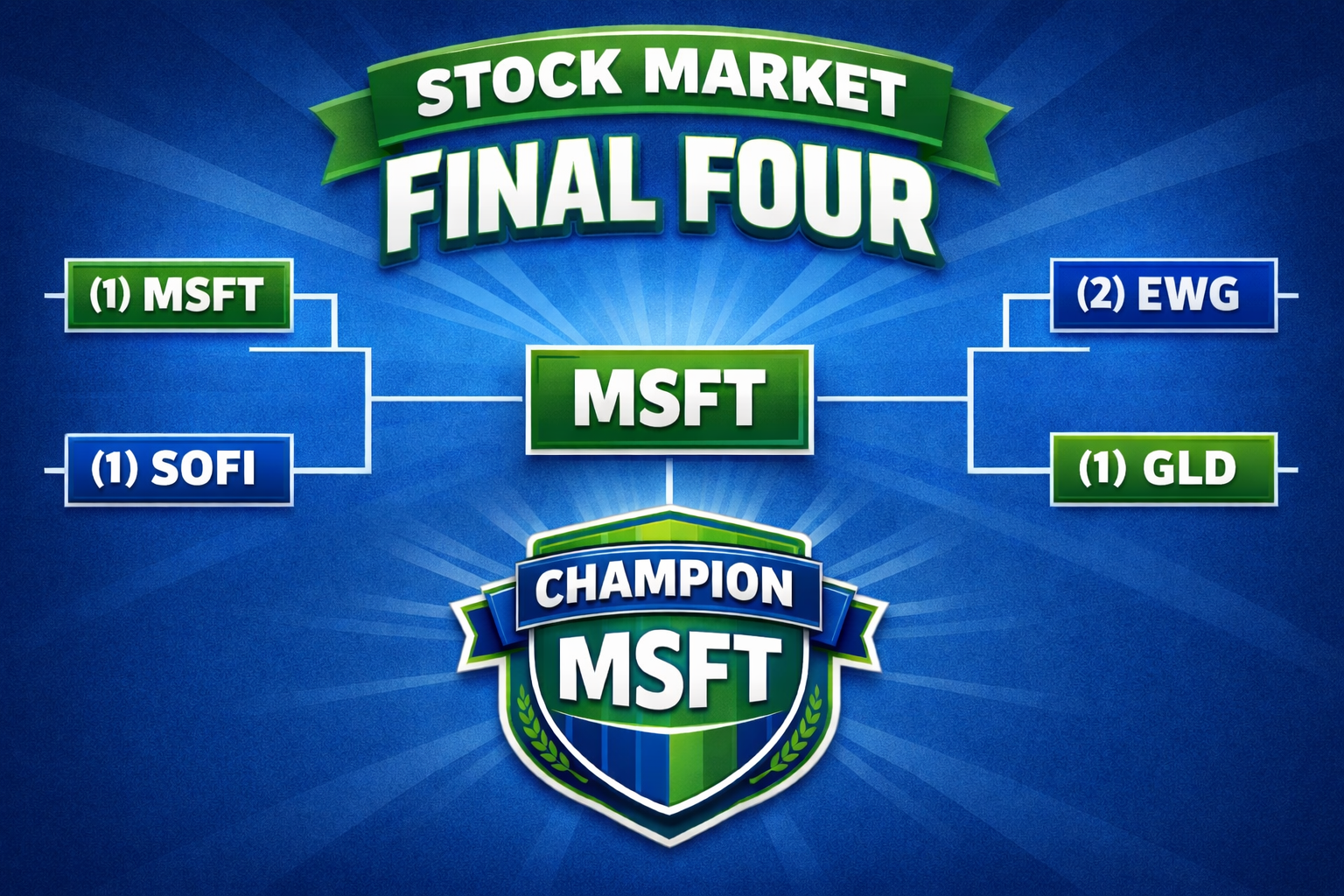
Final Four Portfolio Summary
| Region | Champion | Runner-Up |
|---|---|---|
| Large Cap | MSFT | AMZN |
| Small & Mid Cap | SOFI | SPMD |
| International | EWG | EPOL |
| Bonds & Alternatives | GLD | BTC |
| Tournament Champion | MSFT | GLD |
As always, this bracket is our annual exercise in making our investment thinking public, accountable, and — we hope — useful. Not every pick will work out. Some of our best ideas will lose in the first round. Some 12-seeds will make improbable runs. That’s investing. That’s March.
Check back with us throughout the tournament as we track how the bracket holds up against reality. And if you’re an accredited investor curious about the Aphorio Carter AI datacenter opportunity highlighted in our Bonds & Alternatives bracket, join us on Wednesday, March 25th at 6:00pm at Old Ranch Country Club for an educational dinner event. RSVP to admin@myportfolioguide.com — space is limited.
Neither this article nor anything contained herein constitutes personalized investment advice. Please consult with your financial advisor before making any investment decisions. My Portfolio Guide, LLC is a registered investment advisor.
Well… Mr. Market… we’ll see you on the other side of Selection Sunday. May your bracket survive the first weekend!
— My Portfolio Guide, LLC | www.myportfolioguide.com


 Dear Mr. Market: